

A rich creator-performance model still required an attribution audit before benchmarking.
The synthetic influencer-marketing dataset connected creators, campaigns, products, customers, orders, and campaign-performance records. That structure made it possible to compare reach, revenue, cost, conversion, acquisition, and customer value - but only after checking whether the supplied calculations and attribution fields behaved consistently.
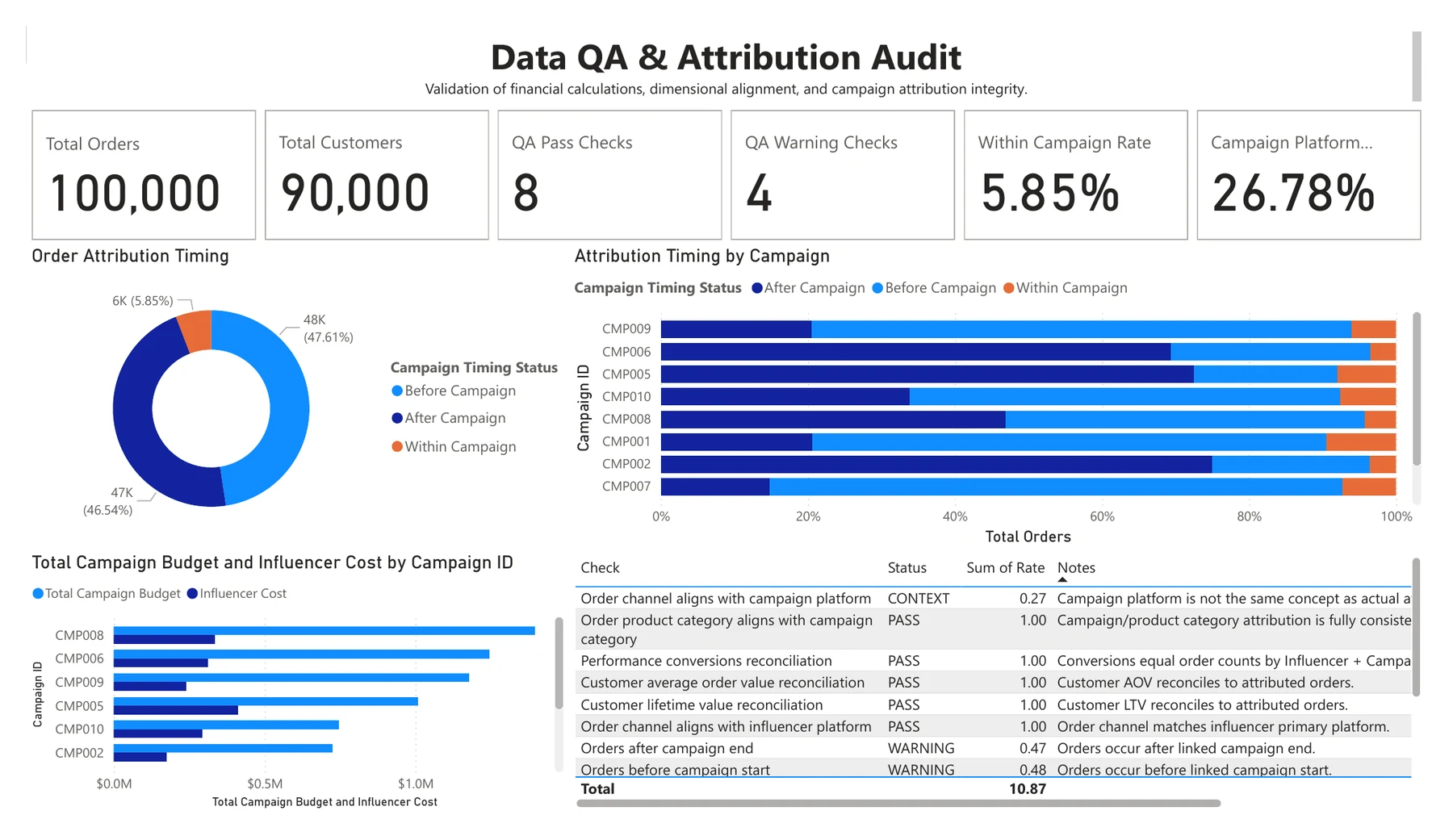
The financial and customer calculations reconciled strongly, while campaign timing exposed a major integrity issue: only 5.85% of orders linked to a campaign occurred inside that campaign's stated start-to-end window. Roughly 47.61% occurred before the linked campaign started and 46.54% after it ended.
Integrity rule: attribution fields were preserved rather than silently corrected. Orders were classified as Before Campaign, Within Campaign, or After Campaign so performance could be analyzed without hiding the timing inconsistency.
How the creator-intelligence audit was built.
- Loaded and standardized the creator, campaign, product, customer, order, and campaign-performance sources in Power Query while preserving named transformation steps for traceability.
- Recalculated order amounts, customer lifetime value, average order value, conversions, campaign revenue, and ROI, then reconciled those values against the supplied fields.
- Built a star-schema model with creator and campaign dimensions shared across order and performance facts, plus product, customer, and date dimensions where appropriate.
- Created data-quality checks for campaign timing, creator-platform alignment, campaign-platform context, product-category alignment, and campaign budget versus modeled influencer cost.
- Added DAX measures for revenue, influencer cost, ROI ratio, cost per conversion, revenue per 1K followers, acquired customers, repeat acquisition, customer LTV, and customer AOV.
- Built three report pages: Data QA & Attribution Audit, Creator & Campaign Performance, and Customer Value & Creator Opportunity.
Three views that separate data trust, creator performance, and customer value.
The report deliberately starts with QA instead of performance. Once the integrity constraints are visible, the next pages compare creator scale and efficiency, then move into acquisition quality and customer value. Select any dashboard to open the full-resolution export.
Review the finished dashboard and working Power BI model.
The PDF contains all three report pages. The PBIX preserves the Power Query transformations, star-schema relationships, QA logic, DAX measures, slicers, creator benchmarks, and customer-value analysis.
File note: the PDF is a static export. Interactive slicers and report behavior are available only in the PBIX through Microsoft Power BI Desktop.
What the validated evidence showed.
- Eight QA checks passed and the supplied order, customer-value, conversion, revenue, and ROI calculations reconciled to the rebuilt logic. The primary integrity problem was attribution timing rather than arithmetic.
- Only 5.85% of the 100,000 attributed orders occurred inside the stated campaign window; 47.61% occurred before campaign start and 46.54% after campaign end. Campaign-linked performance therefore requires temporal caution.
- Order channel aligned with the creator's primary platform across the audited records and campaign/product category attribution reconciled, while order channel aligned with the campaign-platform field only 26.78%. Those platform fields should not be treated as interchangeable without documentation.
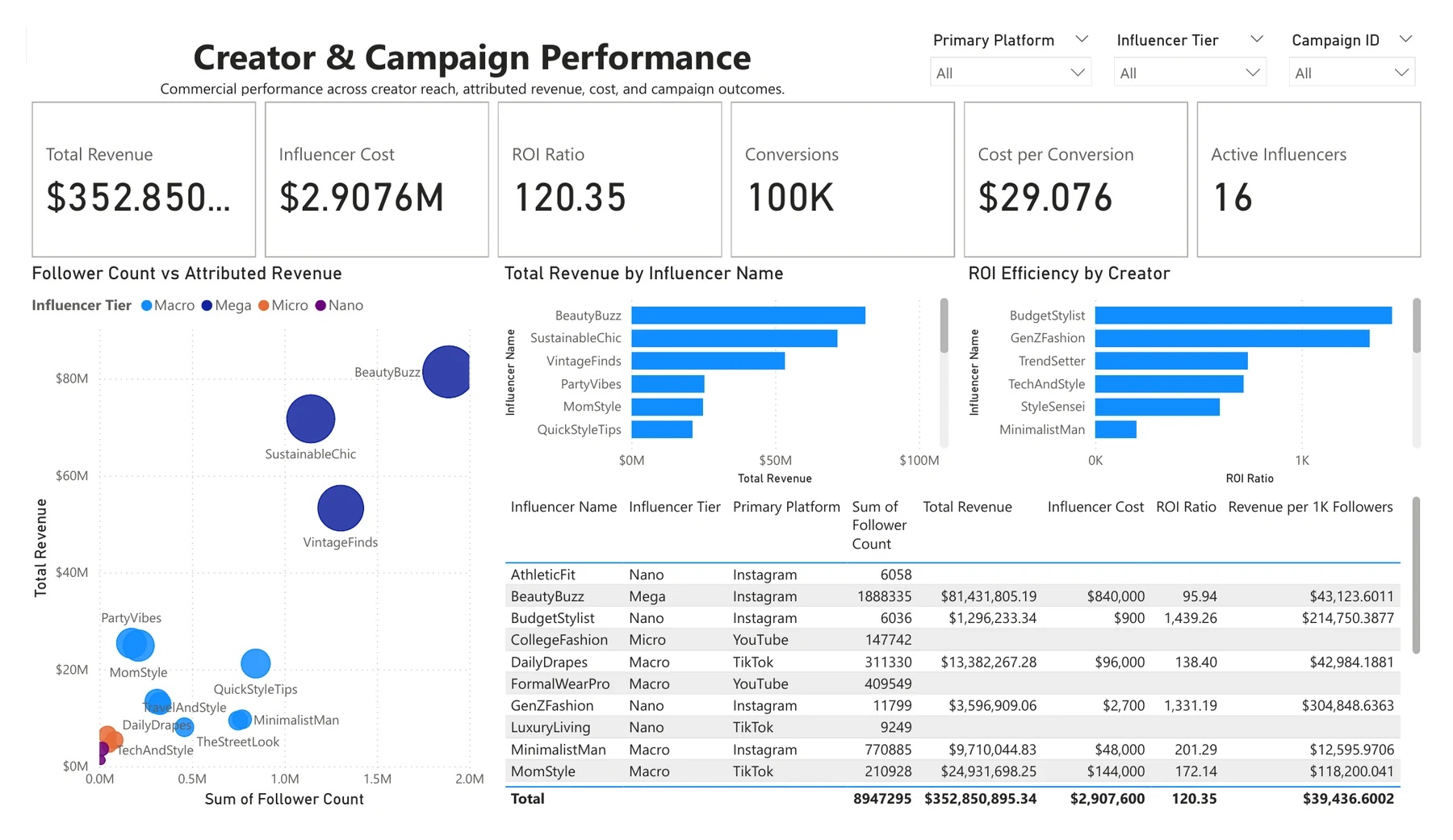
- The model contained $352.85M in attributed revenue against $2.91M in modeled influencer cost, producing a 120.35x overall ROI ratio and about $29.08 cost per conversion. Because the source is synthetic, these magnitudes are useful for method demonstration - not as external market benchmarks.
- Follower count did not tell the full creator-value story. BeautyBuzz led scale with about $81.43M in attributed revenue and a 95.94x ROI ratio, while BudgetStylist generated about $1.30M from only 6,036 followers with a 1,439.26x ROI ratio; GenZFashion reached 1,331.19x.
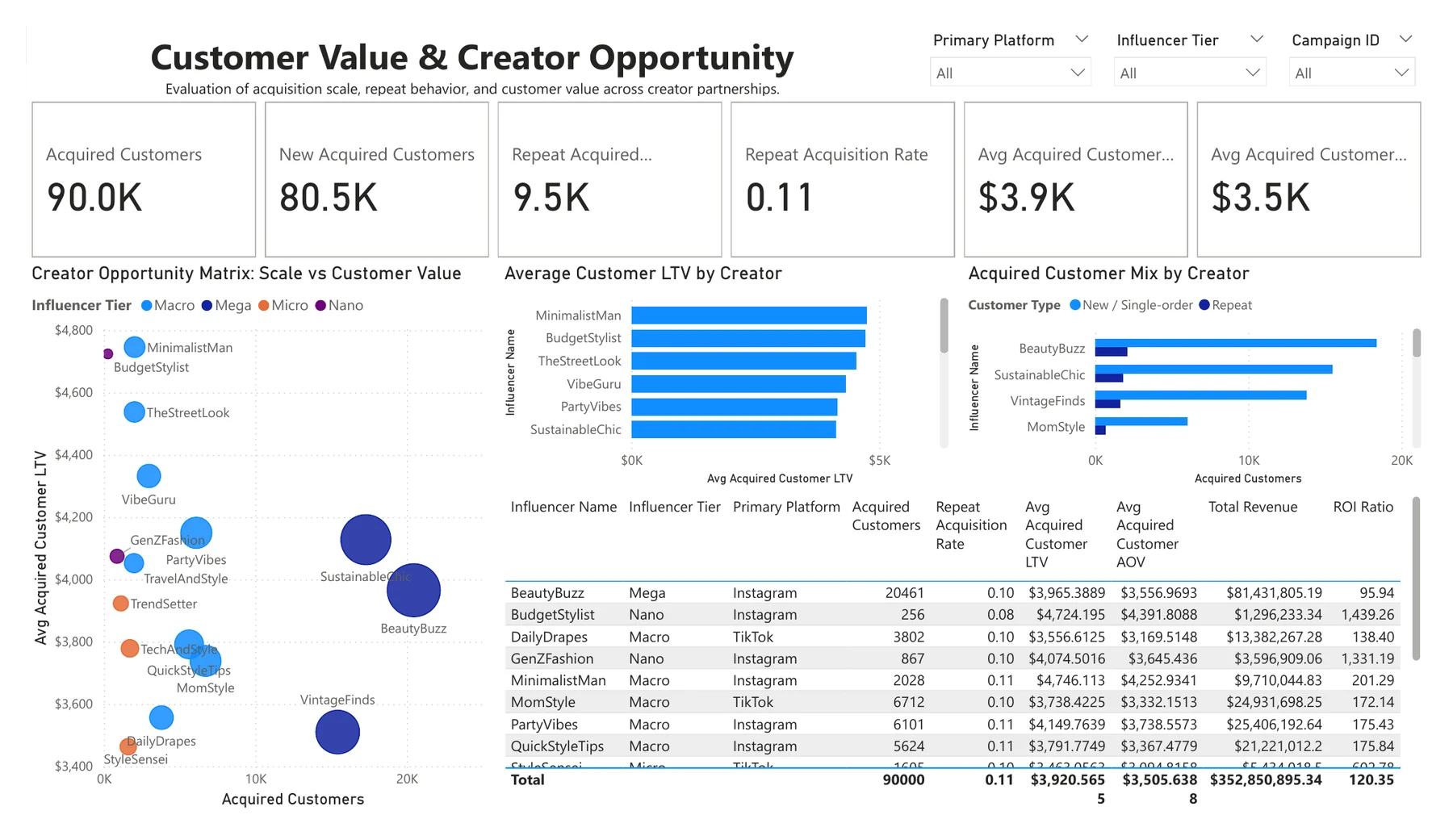
- Customer quality also differed from acquisition scale. BeautyBuzz acquired 20,461 customers with about $3,965 average LTV, while MinimalistMan acquired 2,028 customers but produced the highest displayed average LTV at about $4,746; BudgetStylist was close behind at about $4,724.
How this framework could support creator-partnership decisions.
- Repair or formally define campaign timing attribution before campaign-level ROI is used for operational decisions; performance and attribution integrity should be reported together.
- Evaluate creators with a multi-metric scorecard that combines revenue scale, ROI efficiency, cost per conversion, acquired customers, customer LTV, repeat acquisition, and revenue per 1K followers instead of ranking on follower count alone.
- Separate creator roles: some partnerships are scale drivers, while smaller creators may be efficiency or customer-value drivers. Budget allocation should reflect the objective being optimized.
- Track customer quality after conversion. Acquisition volume alone can hide differences in repeat behavior, average order value, and lifetime value across creator partnerships.
- For future CloutCulture-oriented data, require stable creator identifiers, explicit attribution rules, campaign start/end dates, platform definitions, and provenance metadata so creator intelligence can be benchmarked without reconstructing core semantics.
What this project does - and does not - prove.
This is an original demonstration project built from a synthetic public Kaggle dataset, not observed client campaign data or a production CloutCulture deployment. The simulated revenue, cost, conversion, customer, and ROI magnitudes should not be interpreted as creator-market benchmarks. The attribution-timing inconsistency means the project can demonstrate QA, segmentation, comparative analysis, and decision-framework design, but it cannot establish true causal campaign impact. The creator records are research inputs only: inclusion in this dataset does not represent nomination, verification, participation, or membership in CloutCulture.